
Modelomics Definition
Most AI conversations start in the wrong place.
They start with capability.
Can the model answer the question? Can the agent do the task? Can we make it smarter, larger, faster, or more impressive?
Those are useful questions. But they are not the right first questions.
The right first question is simpler:
How much intelligence does this task actually need?
That is where Modelomics begins.
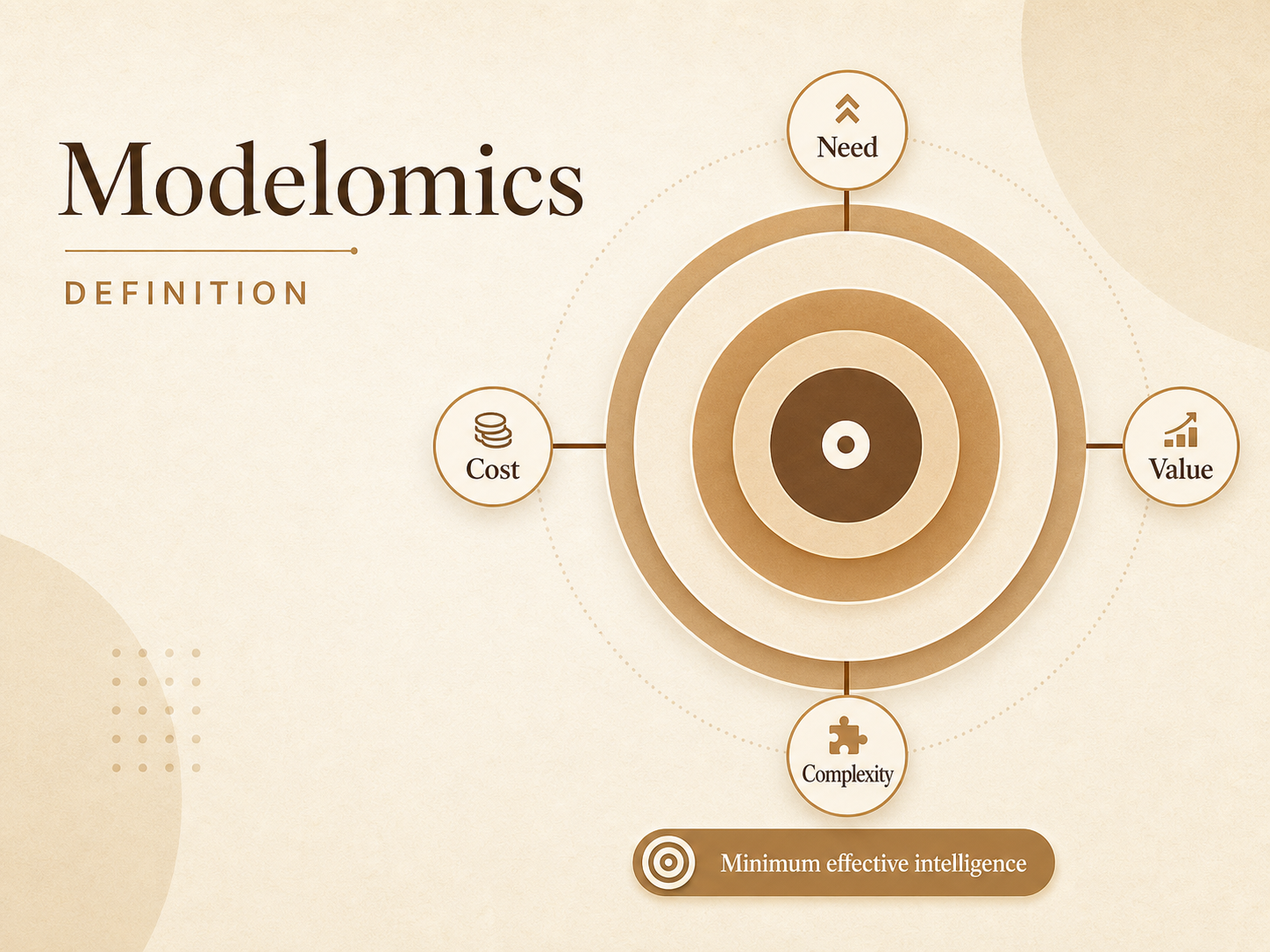
- Modelomics is the practice of allocating AI intelligence efficiently to maximize business value while minimizing unnecessary cost, latency, and complexity. *
It is a discipline for making judgment calls about when to use AI, how much to use, and when to stop.
And that matters more than it may sound.
Because in the age of AI, most organizations are not short on intelligence. They are short on discipline.
The Real Problem
Many teams are overspending on AI.
Not only in budget, but in complexity.
They add intelligence because they can, not because they should. They use large systems where smaller ones would do. They escalate too early. They build workflows that are impressive in a demo and expensive in practice.
The result is a familiar kind of product decay:
- more latency
- more cost
- more fragility
- more maintenance burden
- more confusion about what the system is actually doing
This is not a model problem.
It is an allocation problem.
The Shift
The shift Modelomics names is simple but important:
intelligence is becoming abundant, but efficient allocation is still scarce.
That means the hard part is no longer only access to capability.
The hard part is deciding where that capability belongs, how much of it to use, and how to avoid waste.
The Five Terms
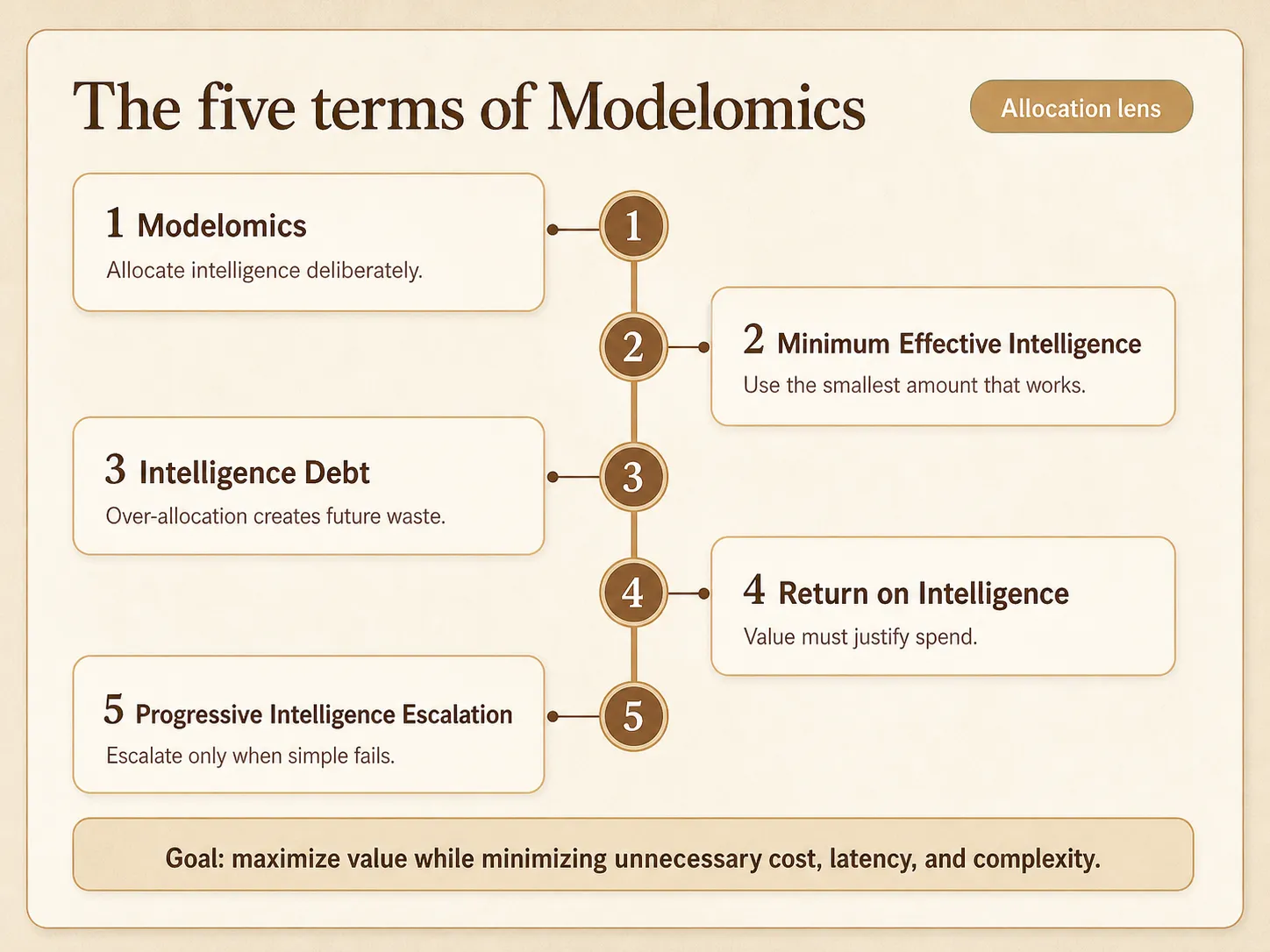
Modelomics starts with five concepts.
Modelomics
The overall concept.
It is the practice of deciding where intelligence should be used, how much should be used, and what tradeoffs are acceptable in order to maximize business value.
Minimum Effective Intelligence
The smallest intelligence required to complete a task successfully.
This is a principle of restraint.
If a simpler approach works, use it.
Intelligence Debt
The accumulated waste from over-allocating intelligence.
Every unnecessary layer of intelligence creates cost, latency, and complexity that eventually has to be paid for.
Return on Intelligence
Business value generated per unit of intelligence spend.
This is the economic check.
If the value does not justify the cost, the allocation is wrong.
Progressive Intelligence Escalation
Escalate only when lower-cost intelligence fails.
This keeps teams from defaulting to expensive intelligence when cheaper intelligence would have been enough.
What Modelomics Is Not
Modelomics is not model training. It is not AI research. It is not benchmark chasing. It is not prompt engineering. It is not LLM development.
Those things matter, but they are different disciplines.
Modelomics sits above them as an allocation lens.
Why It Matters
The best AI systems are not always the most intelligent ones.
They are the ones that use intelligence well.
That is why Modelomics matters. It gives teams a way to ask better questions:
- Is AI needed here at all?
- If so, what is the minimum effective intelligence?
- What return are we getting?
- Are we creating debt?
- Should we escalate?
Those questions lead to better design, better economics, and better products.
The next three articles translate the same idea for founders and operators, engineers and product teams, and executives and decision-makers.
Closing Thought
The future of AI will not be decided only by who has the smartest models.
It will be decided by who allocates intelligence best.
That is the promise of Modelomics.