

Governance Lens
If you want the canonical definition first, read Modelomics Definition.
This is the governance lens.
Most executives do not need another AI demo. They need a better way to decide whether AI is creating value or just creating noise.
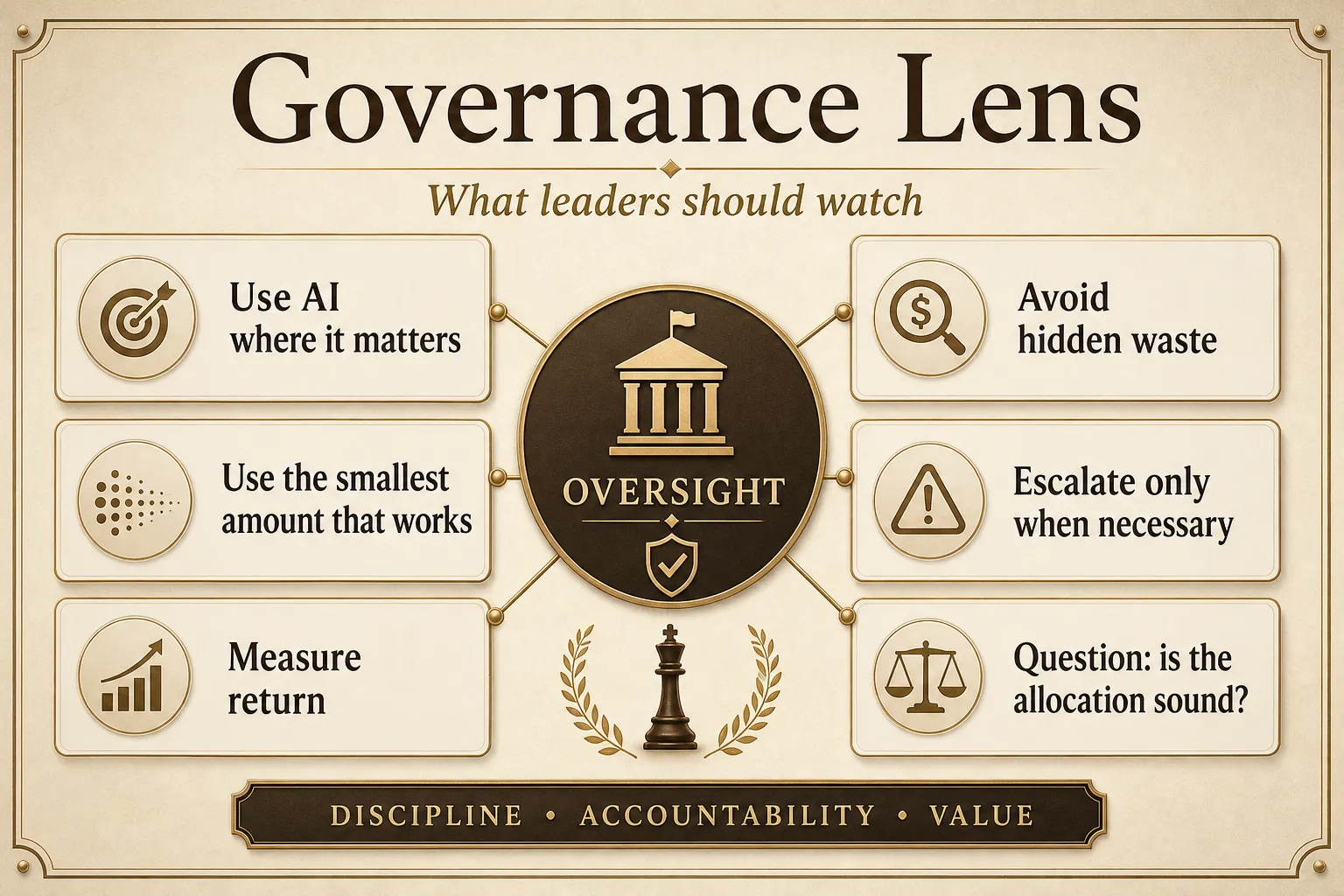
In executive terms, Modelomics means:
- use AI where it matters
- use the smallest amount that works
- measure the return
- avoid hidden waste
- escalate only when necessary
That is not a technical detail.
That is operating discipline.
The Executive Problem
Many organizations are making the same mistake with AI: they are optimizing for capability instead of allocation.
Capability is seductive.
It is easy to look at a powerful model and assume the answer is to use more of it everywhere. But more capability does not automatically mean more value.
Sometimes it means:
- more cost
- more complexity
- more risk
- more friction
- more dependency
Those costs show up later, after the demo has been celebrated.
The Five Terms in Executive Language
Modelomics
The discipline of deciding how AI capability should be allocated across the business.
Minimum Effective Intelligence
The smallest intelligence needed to get the job done.
This is the standard for efficiency.
Intelligence Debt
The waste created when the organization uses more intelligence than the task requires.
This is the hidden tax.
Return on Intelligence
The value generated for each unit of intelligence spend.
This is the leadership metric.
Progressive Intelligence Escalation
Escalate only when lower-cost intelligence fails.
This is the governance rule.
What Leaders Should Watch For
Executives should be wary of AI initiatives that are:
- impressive but expensive
- useful but hard to maintain
- powerful but poorly measured
- smart in theory but slow in practice
These are often signs of poor allocation.
The question is not whether the technology is advanced.
The question is whether the allocation is sound.
What Good Governance Looks Like
A Modelomics-informed leadership team asks:
- What problem are we solving?
- How much intelligence does it need?
- What is the return?
- What debt are we creating?
- Is there a simpler way?
- When should we escalate?
Those questions create a healthier decision culture.
They also reduce the chance that AI becomes a cost sink disguised as innovation.
Why This Matters Now
AI is becoming cheaper to access and easier to add.
That is exactly why organizations need better discipline.
When capability becomes abundant, the scarce skill becomes allocation.
The organizations that learn this early will:
- move faster
- waste less
- scale more cleanly
- make better tradeoffs
- avoid unnecessary complexity
That is a strategic advantage.
Closing Thought
Modelomics is not a call to use less intelligence everywhere.
It is a call to use the right amount of intelligence in the right place.
That is how leaders turn AI from a fascination into a business advantage.