
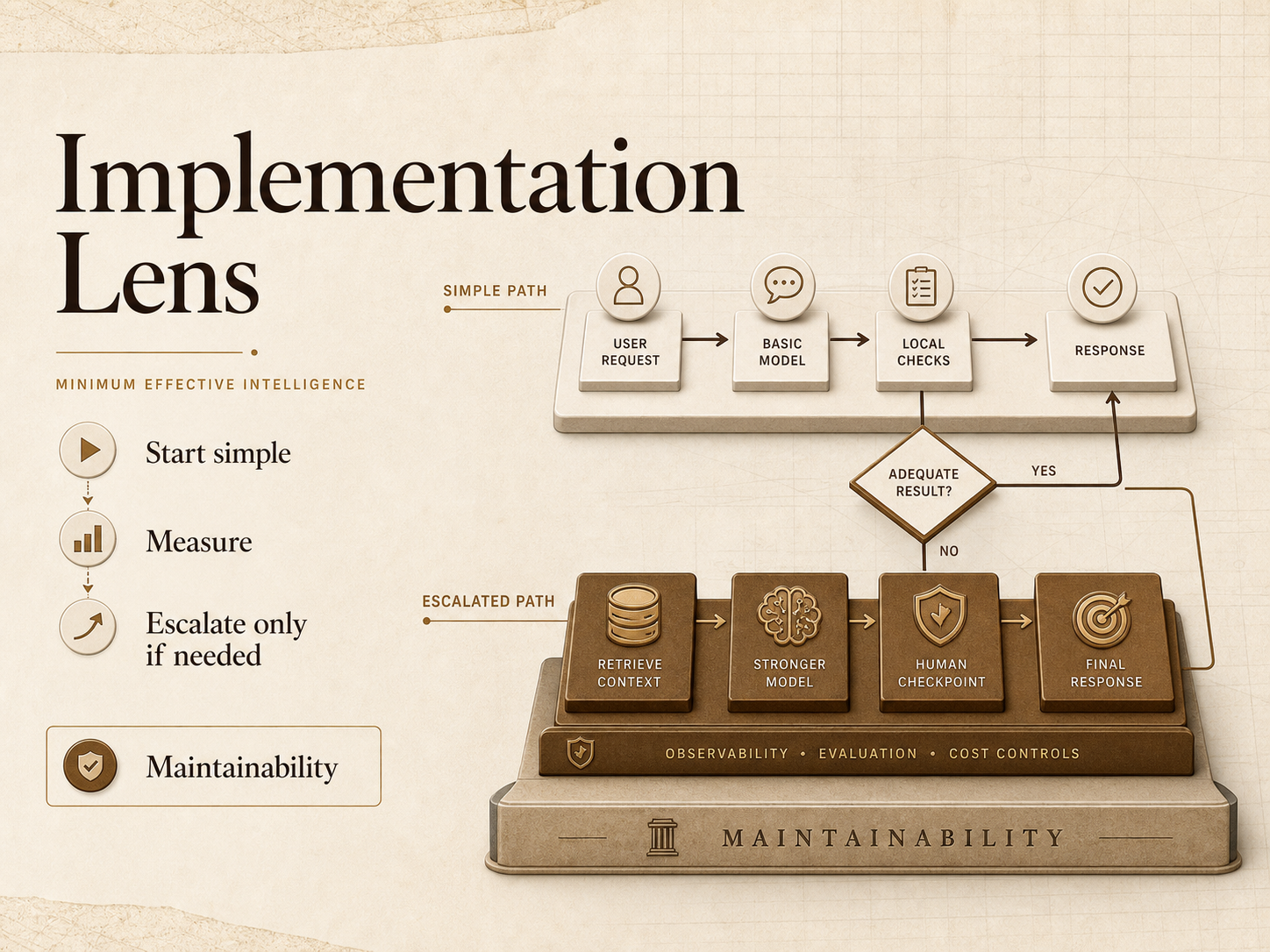
Implementation Lens
If you want the canonical definition first, read Modelomics Definition.
This is the implementation lens.
Engineers and product teams feel AI decisions in system behavior, support tickets, testing burden, and how much work it takes to keep the product understandable.
The real cost is:
- slower systems
- awkward edge cases
- brittle logic
- confusing behavior
- harder debugging
- more support issues
- more work for the people closest to the product
That is where Modelomics becomes useful: it turns intelligence allocation into a design constraint instead of a late-stage accident.
The Wrong Default
Modern product teams often default to the most impressive AI option available. That can feel like progress, but it often creates a system that is harder to understand than the problem it was supposed to solve.
If every task gets a large model, a multi-step workflow, or an agentic layer, the system may become more capable and less usable at the same time.
That is not good product design.
That is over-allocation.
MEI Is a Product Principle
Minimum Effective Intelligence, or MEI, is the smallest intelligence required to complete a task successfully.
That is a powerful product principle.
It forces teams to ask:
- What is the task?
- What is the smallest thing that can solve it well?
- What failure rate is acceptable?
- Is AI needed at all?
- Would a simpler rule, workflow, or model work better?
These are design questions, not just technical questions.
Intelligence Debt Shows Up in the Codebase
Intelligence Debt is the accumulated waste from over-allocating intelligence.
In practice, engineers feel it as:
- overly complex orchestration
- too many branching paths
- hard-to-test behavior
- expensive retries
- hidden dependencies
- more brittle integration points
Product teams feel it too.
They experience it as unclear user journeys, unpredictable performance, and features that are difficult to explain.
RoI Should Shape the Roadmap
Return on Intelligence is business value generated per unit of intelligence spend.
That makes it a product and engineering metric, not just a finance metric.
If a feature costs more intelligence than the value it creates, the roadmap needs a rethink.
RoI gives teams permission to say:
- this does not need a bigger model
- this does not need an agent
- this should be simpler
- this should be escalated only if the cheaper path fails
That is a healthy product posture.
PIE Is How You Build Responsibly
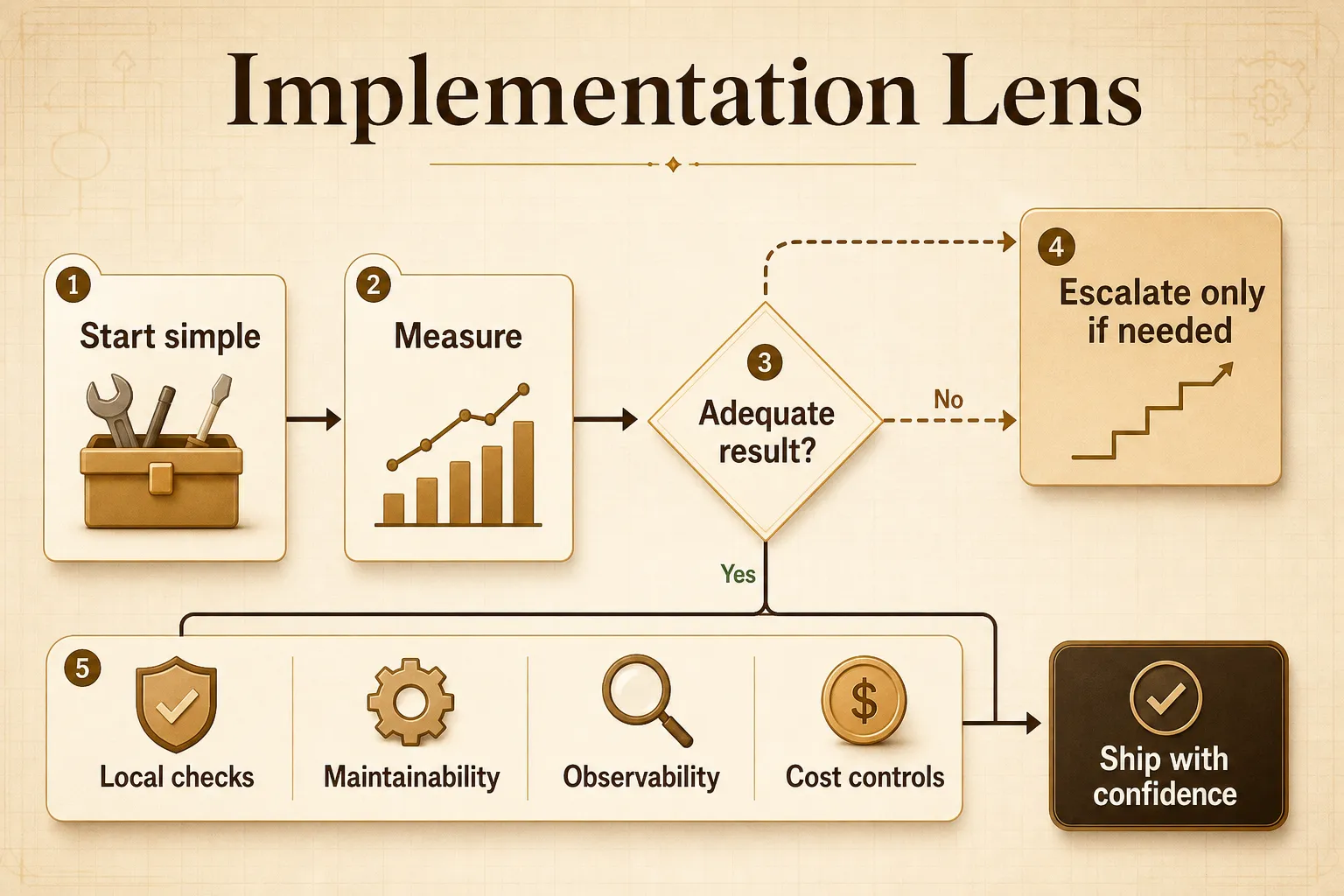
Progressive Intelligence Escalation means you only escalate when lower-cost intelligence fails.
For teams, that suggests a practical sequence:
- Start with the simplest viable approach.
- Measure it.
- Escalate only if the results are not good enough.
- Keep the fallback path obvious.
- Avoid building the expensive version first.
This is especially useful in AI product work because the temptation to overbuild is everywhere.
A Better Engineering Mindset
Modelomics is not anti-AI.
It is anti-waste.
It helps teams build systems that are:
- easier to reason about
- easier to maintain
- cheaper to operate
- faster to iterate
- more honest about tradeoffs
That is a better engineering outcome.
And it is a better product outcome too.
Closing Thought
Great product teams do not just ask, “Can we add AI?”
They ask, “What is the minimum effective intelligence?”
That one question changes the shape of the product.
And if they keep asking it, they usually ship better systems.